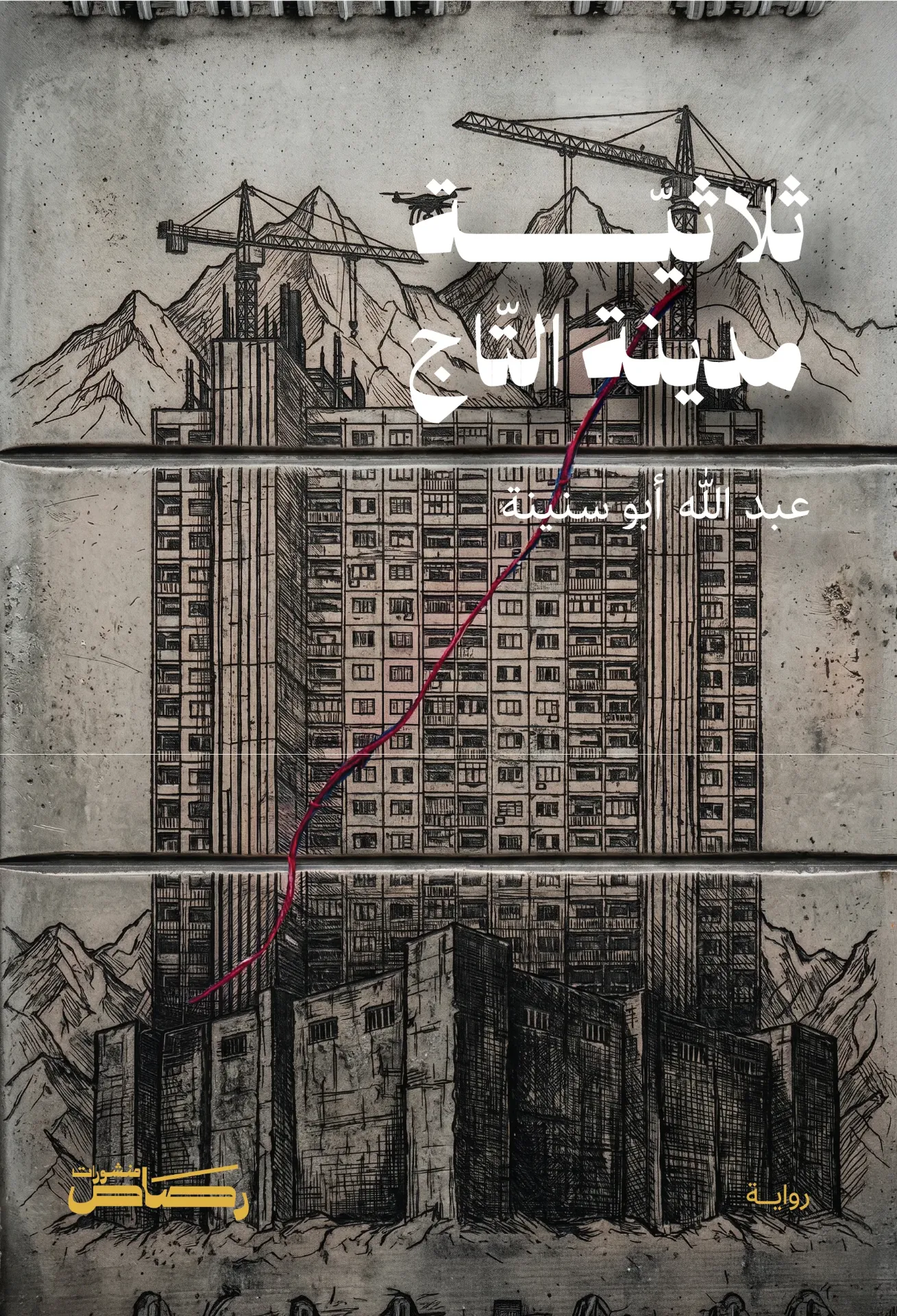
ثلاثية مدينة التاج
In a world governed by the authority of the **“center,”** where fate seems determined to cast human tragedies onto the **“margins,”** writer **Abdullah Abu Snaina** presents a distinctive narrative that leads readers beyond the boundaries of crime and punishment. This is not a conventional revenge story, but an experimental structure built on multiple voices and a three-part alternation, beginning with a door that opens from an authentic prison cell and gradually forming a tightly constructed circular narrative whose fragments ultimately converge at a single point.
What first appears to be a straightforward tale of pursuit transforms into a profound examination of a city suffering from a moral distortion that mirrors its physical decay. With every step, Abu Snaina skillfully employs the geography of place to reflect the psychological states of his characters. The city itself becomes more than a setting—it becomes a living presence that carries the weight of its inhabitants’ wounds, contradictions, and failures.
The search for justice here is not a simple path toward resolution, but a complex journey through the uncertain spaces between the slow logic of law and the fierce instinct for personal revenge. The novel explores a society where humanity gradually erodes, leaving its people searching for purification through the only language they believe remains: blood and ashes.
Through its fragmented structure, shifting perspectives, and dark exploration of justice, violence, and human desperation, the work raises a haunting question: **When institutions fail to heal a wounded society, what remains of humanity when revenge becomes the final form of justice?**
عبد الله أبو سنينه