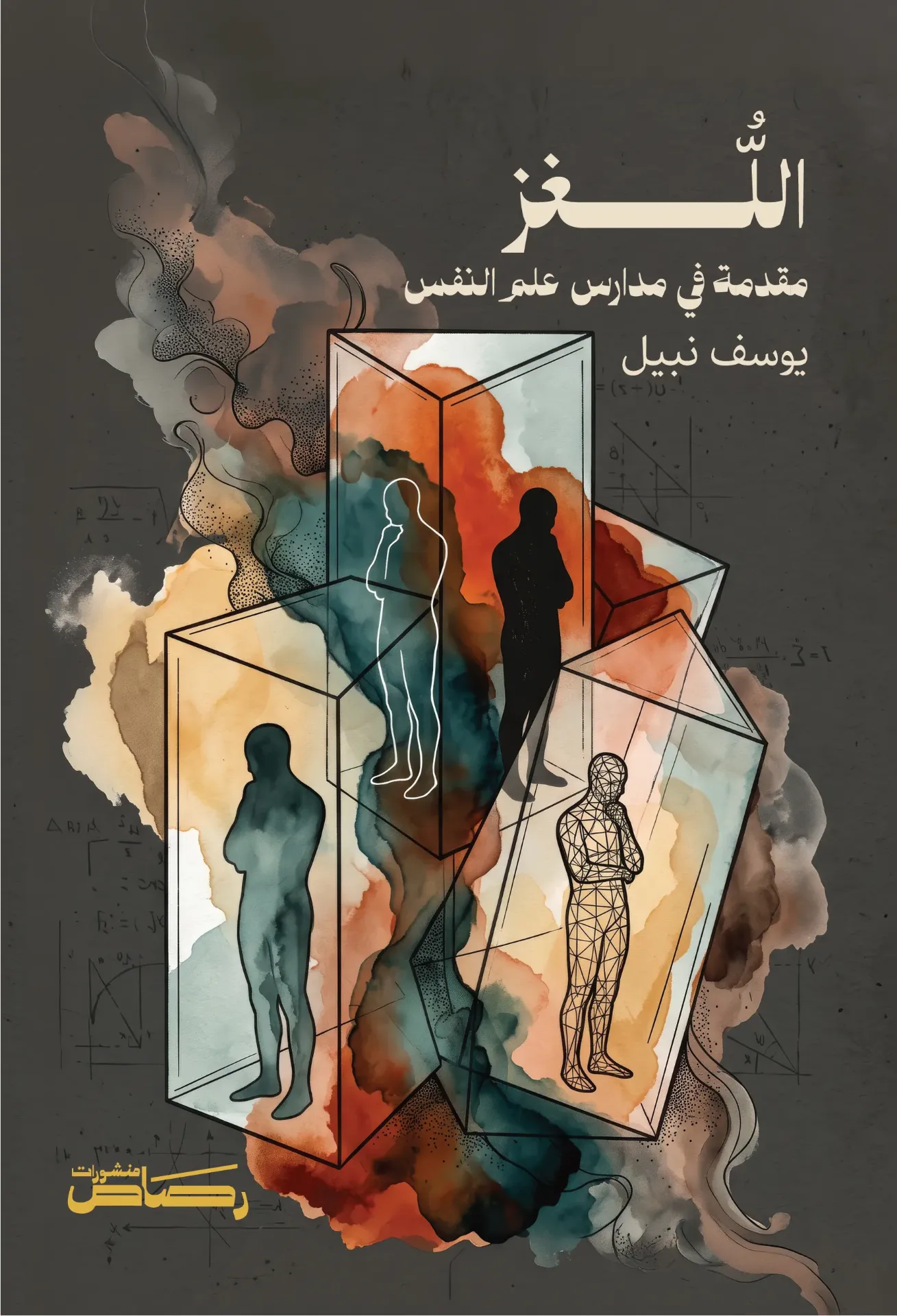
اللغز: مقدمة في مدارس علم النفس
Have you ever wondered what truly drives your everyday actions? Is it your conscious will and rational decisions, or hidden forces buried deep within your childhood and behavioral patterns shaped by your surroundings without your awareness?
In the darkness of the last century, the psychologist **Gustav Fechner** posed a striking question: *What if the human mind is like an iceberg floating in a cold sea—the smaller part visible above the surface, while the vast majority remains submerged in darkness?*
From this unsettling idea, **Yousef Nabil** takes us through **The Enigma: A Brief History of Schools of Psychology**, a book that explores the fierce intellectual battles fought by some of history’s greatest thinkers in their attempt to decode humanity and understand the mysteries behind human behavior.
The journey begins with how earlier civilizations understood the self—when the soul was viewed as a spiritual essence connected to the body, as explored in the philosophies of **Aristotle**, **Avicenna (Ibn Sina)**, and **Ibn Khaldun**. But the path soon takes a dramatic turn toward the age of strict materialism.
Here, readers encounter the disruptive rise of **behaviorism**, led by figures such as **John B. Watson** and **B. F. Skinner**, who sought to strip human beings of the traditional concepts of consciousness and free will, redefining people as almost "mechanical systems" shaped by their environments. In this view, emotions, fears, and even creative thoughts become responses conditioned by the rewards and punishments accumulated throughout one's life.
The book follows the transformation of psychology from a philosophical inquiry into a modern scientific struggle, where laboratories attempted to dissect consciousness itself and reduce the mysteries of the mind into measurable biological and chemical processes.
**The Enigma** is not merely a history of psychological theories—it is a journey through humanity’s ongoing attempt to answer one of its oldest questions: *How much of who we are is truly ours, and how much has been written into us before we ever realized it?*
يوسف نبيل